

Artworks that echo and mirror each other
VINCENT VAN GOGH: SORROWING OLD MAN
KAWS: COMPANION (PASSING THROUGH)
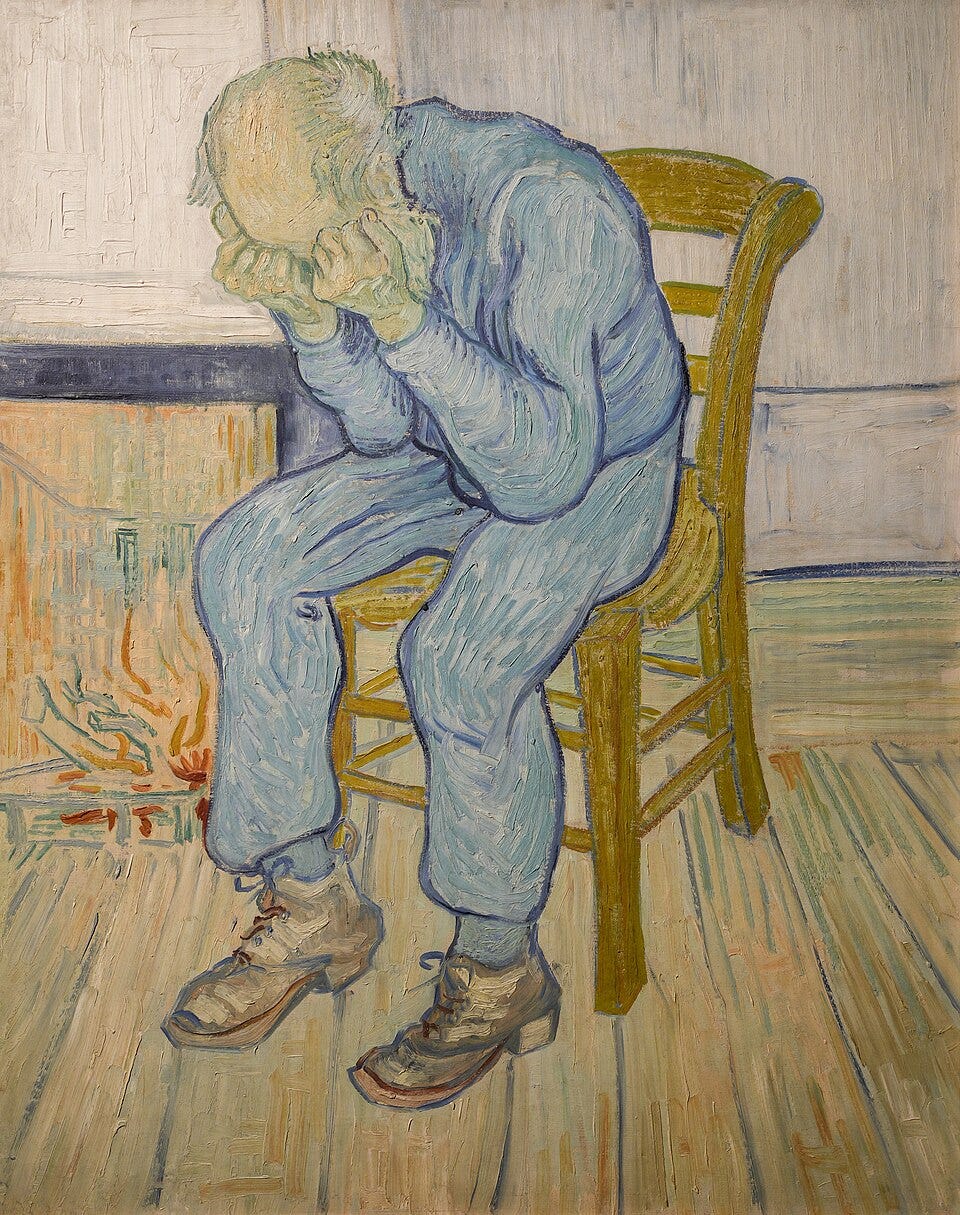
Grief. Sadness. It’s one of the easiest emotions to read via body language; therefore it’s one of the easiest to make art about. Also it’s one of the most universal and basic emotions because we live in a fallen and broken world and there’s a lot to be sad about. There’s something universal about grief, and I would argue there’s something pervasive about grief the older one gets, the longer one has spent on this planet; so if you’re an old man you probably exist in a state of near-constant grief. What do old men have to be sad about? Basically everything. They were once young and virile and now they are humiliated by the weaknesses of their aging bodies. They remember what it was like to be young yet they can see the “kids these days” making the stupidest of choices. And on and on. So when Van Gogh painted a picture of a crying old farmer he was tapping into something universal about the human condition. We have all been sad like Van Gogh’s old man. Thus when Brian Donnelly makes a goofy statue that looks like Mickey Mouse with a kawaii-ified skull and crossbones instead of a normal head and makes it in the universally recognized weeping / grieving pose, his character suddenly becomes someone we can relate to. We can look at his ugly sculpture and think about the human condition.

FRANS SNYDERS: LYING LIONESS
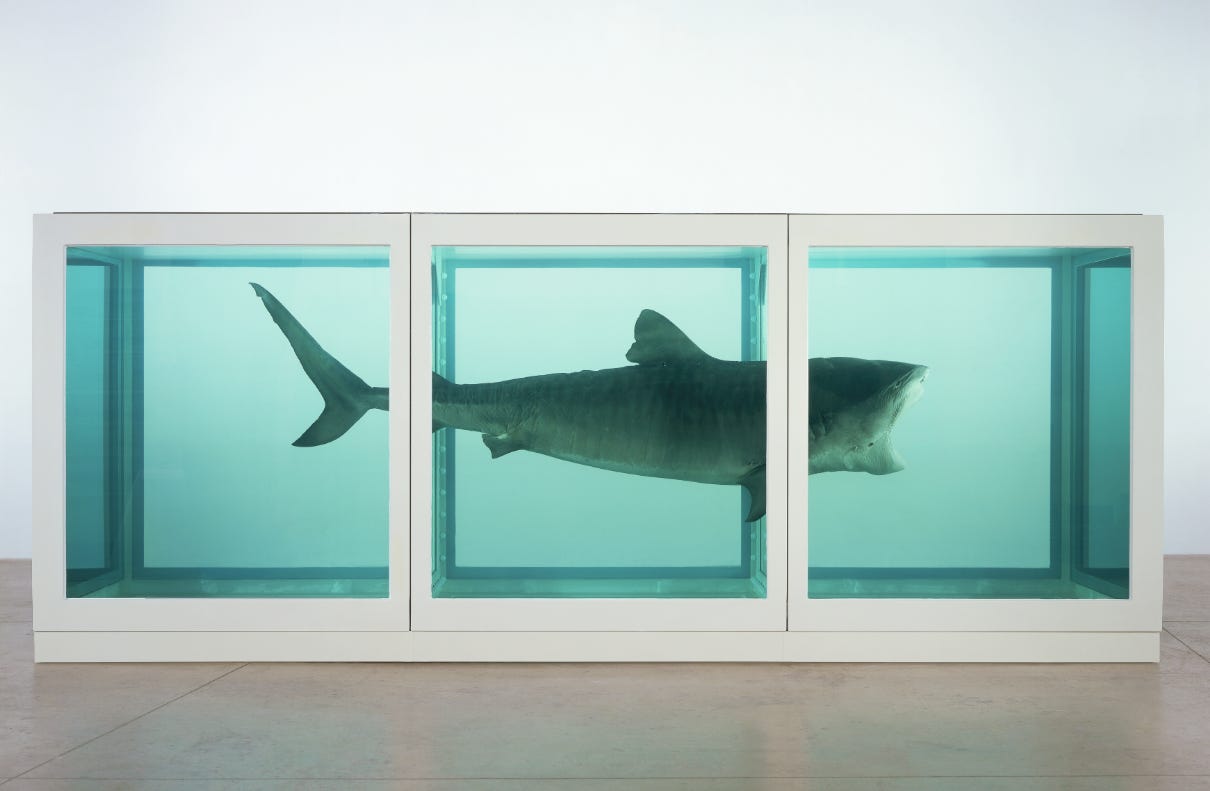
DAMIEN HIRST: THE PHYSICAL IMPOSSIBILITY OF DEATH IN THE MIND OF SOMEONE LIVING
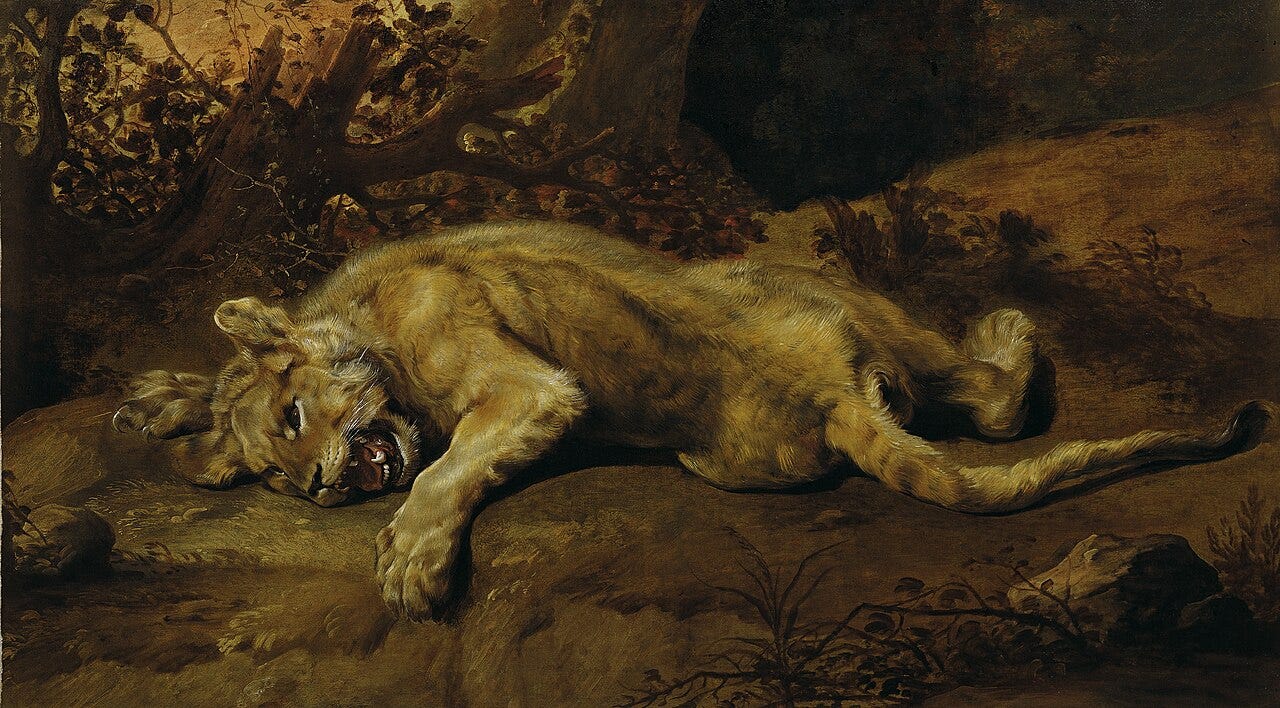
What does it feel like to come face-to-face with a ferocious predatory animal which could instantly kill you if it wanted to? The closest that the mid-17th-century Dutch bourgeoisie would get to such an encounter would probably have been via paintings such as this one by Frans Snyders. It is life-size and you can walk right up to it and look at the lion’s fangs and claws for as long as you want to since it’s not actually a real lion and can’t actually kill you. Today we have a modern equivalent: we can stroll around Damien Hirst’s stuffed shark and admire the beast’s ferocity, which has, similar to that of Snyders’ lion, been rendered harmless by being encased in glass. Hirst specifically asked for a really fierce shark, a potential man-eater, for this artwork. Snyders’ work was only ever little gobs of colored oil on canvas, though—Hirst’s was a real live shark once; that exact creature could have potentially killed and eaten a human being—does this fact affect your experience of looking at it?
GEORGES SEURAT: YOUNG WOMAN POWDERING HERSELF
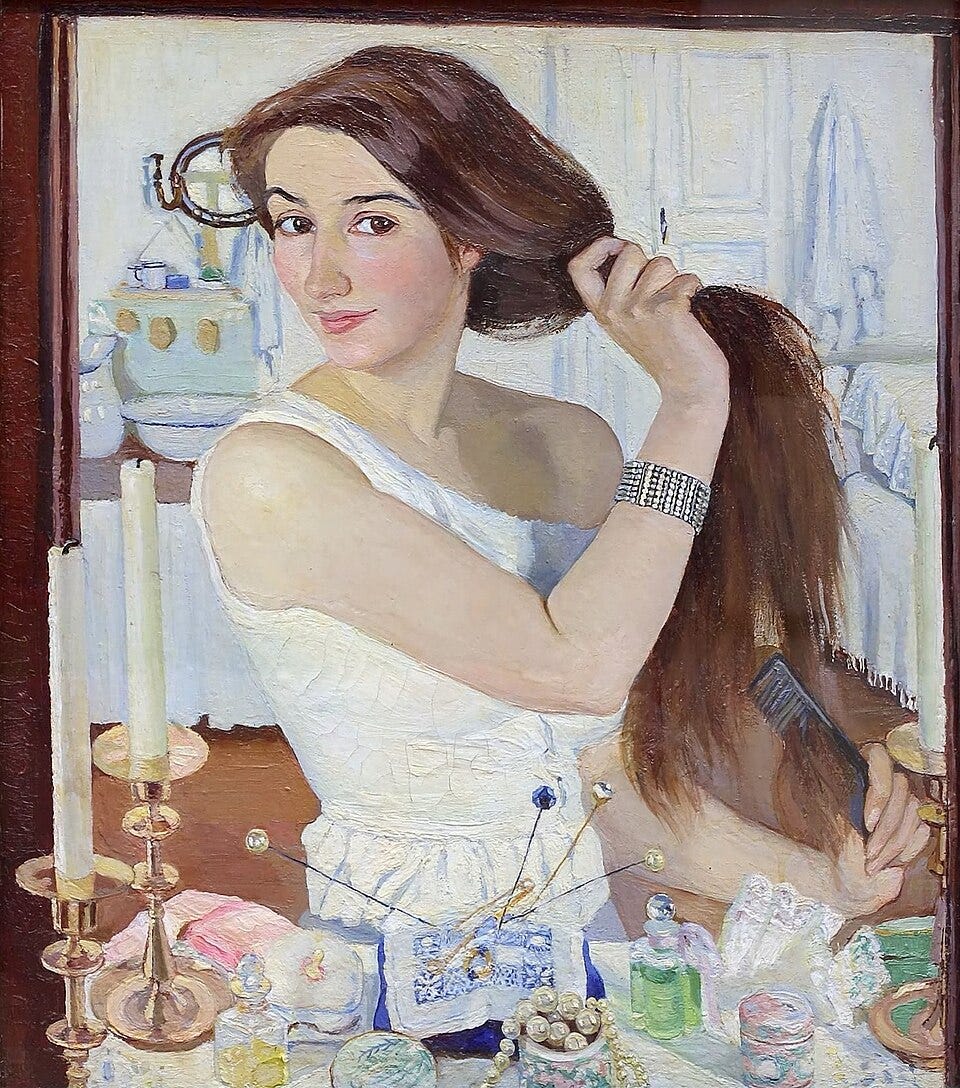
ZINAIDA SEREBRIAKOVA: SELF-PORTRAIT AT THE DRESSING TABLE
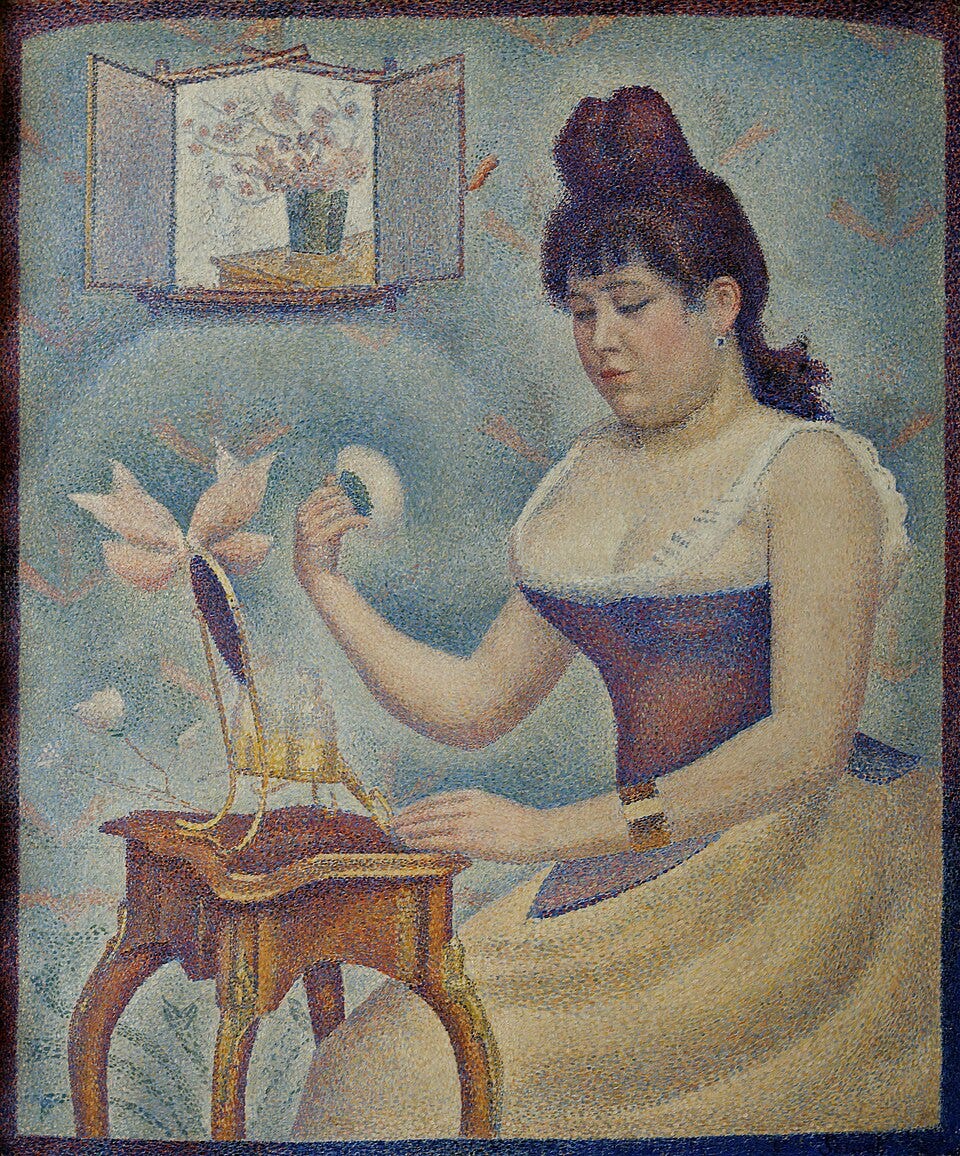
Seurat’s young woman is shown beautifying herself, but she doesn’t seem aware that we are watching her doing it. Why is she doing her makeup? What is she thinking? She is forever at a distance from us, forever objectified—we can never really know her mind and can only project ourselves on to her. I suppose this means Seurat’s painting is a good one on which to hang any of our theories about the male gaze, beauty standards, domesticity, and on and on. But we can’t really know why Seurat painted her either or what he himself was thinking. Not so Serebriakova’s self-portrait. She’s doing the same thing as Seurat’s mistress: “preparing,” as Eliot says in Prufrock, “a face to meet the faces that we meet” . . . but we can know exactly what Serebriakova is thinking. She projects a kind of confidence not often seen in pictures of women done by men. I maintain this is the most self-confident woman in all of art; the only picture even remotely close is Ingres’ portrait of the sitting Madame Moitessier, and that one is full of a calm confidence, but this one is full of an active confidence. And the light! In the Seurat it gets diffused all over the place into his fussy little dots; but Serebriakova is apparently lit from the mirror: everything is bathed in the most radiant white light imaginable; Seurat may have broken the light into prismatic colors but Serebriakova is painting the beam before it gets into the prism.
EDMUND LEIGHTON: STITCHING THE STANDARD
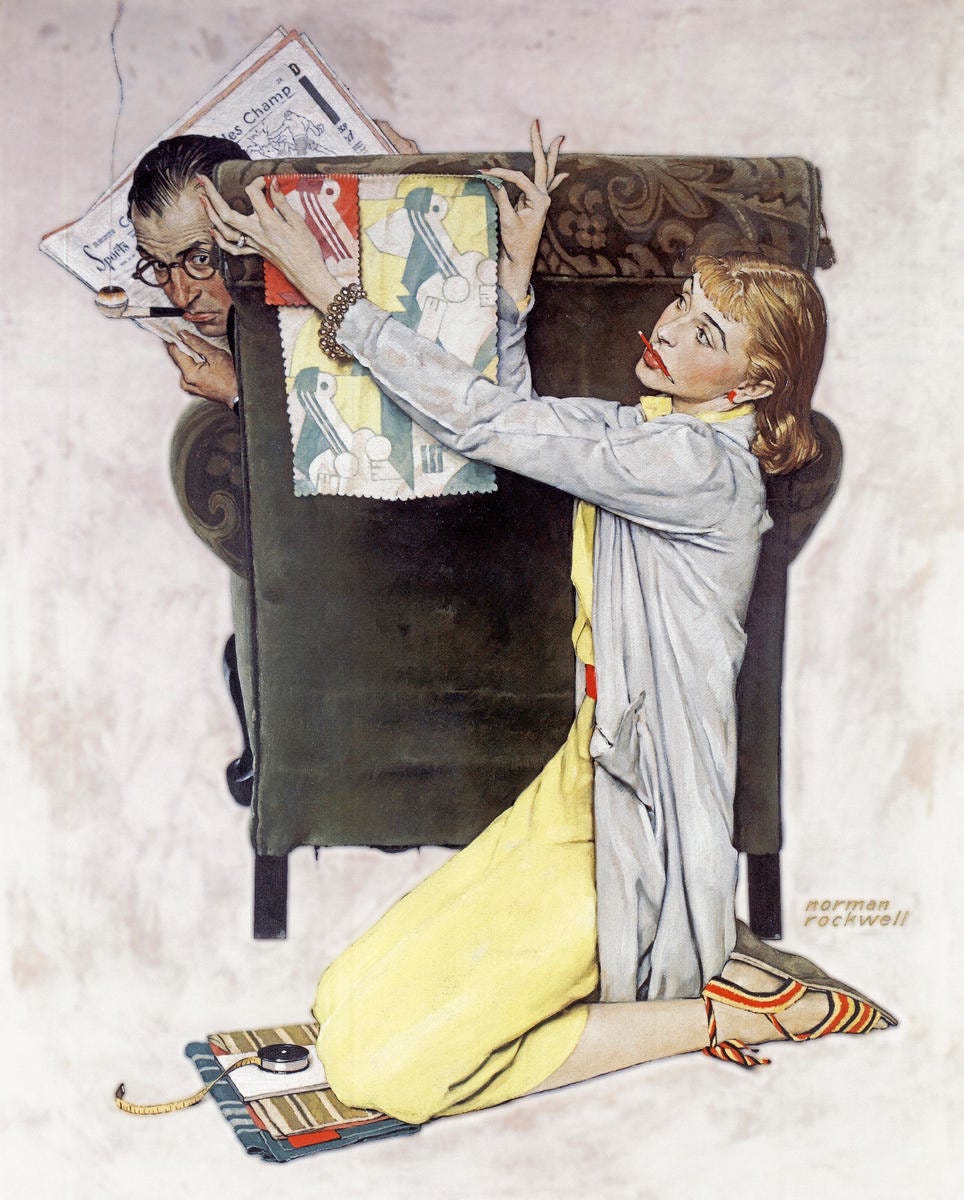
NORMAN ROCKWELL: THE DECORATOR
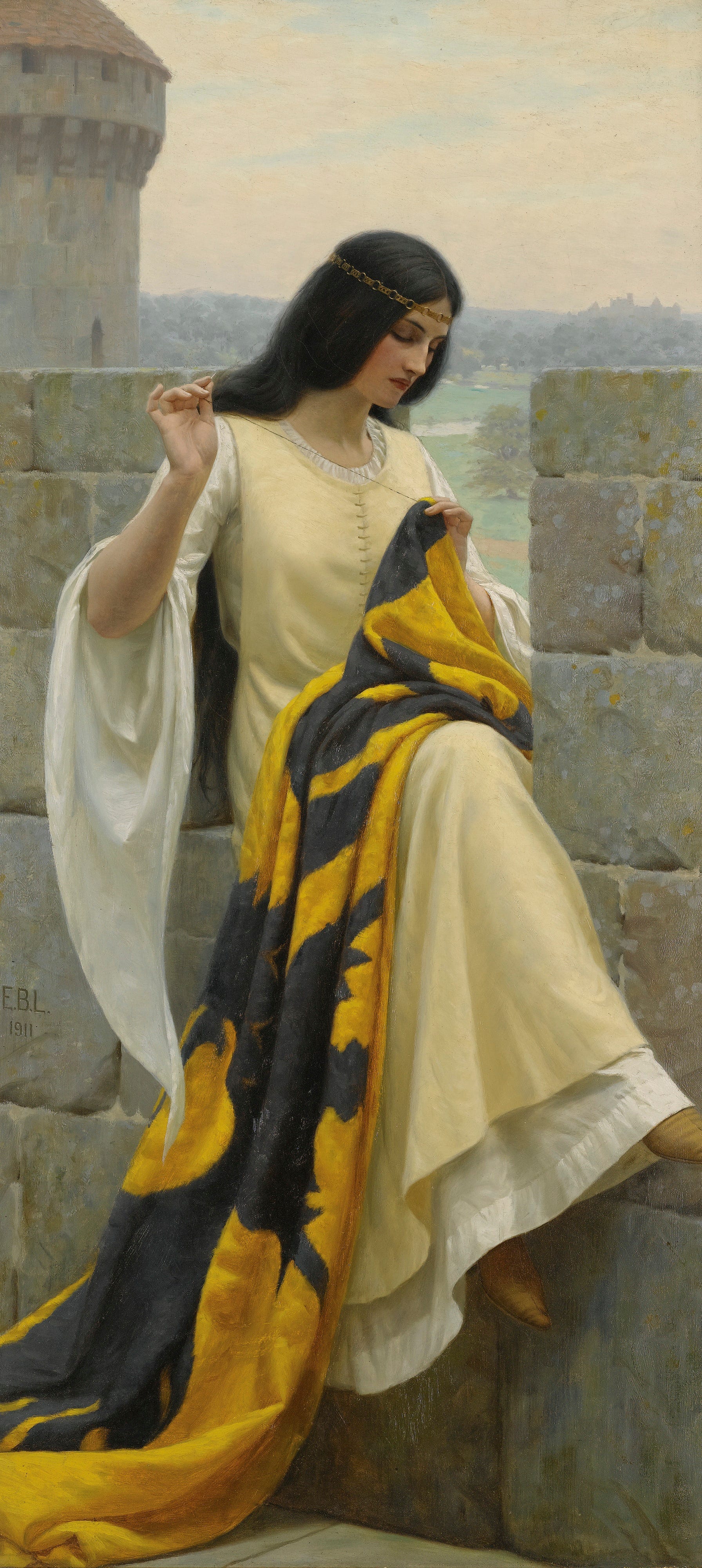
Ah yes, sewing . . . a stereotypical female occupation. What were medieval maidens supposed to do for the war effort anyway? . . . they couldn’t go off with their menfolk and fight in the crusades; they supported the effort at the home front, and in this case we’re shown one such medieval damsel preparing the flag that her knight will take into battle. Why is she doing it on the rampart? I don’t know. Leighton was fond of making these pictures of medievalism which, to be sure, have the same sort of fan-service sourness that many of the Pre-Raphaelites indulged in: I’m being too forcefully invited to stare at the pretty girl, and I don’t like it. Norman Rockwell, on the other hand, never to my knowledge painted a woman as an object. His girls are all being a part of the world; either working on the home front riveting or volunteering; or they’re holding up the machinery of the judicial system or being utterly ignored by oafs, or pondering their own selves or all sorts of other things. In Rockwell’s picture of a woman messing about with fabric our attention is actually directed away from the woman and towards the man who is undoubtedly thinking something like “okay now what’s she going to do to my favorite comfy chair?” and we can build a whole narrative around this painting. There ought to be fanfiction about it.
UNKNOWN ARTIST: THE CANNING JEWEL
CLAES OLDENBURG: THE RAY GUN WING OF THE MOUSE MUSEUM
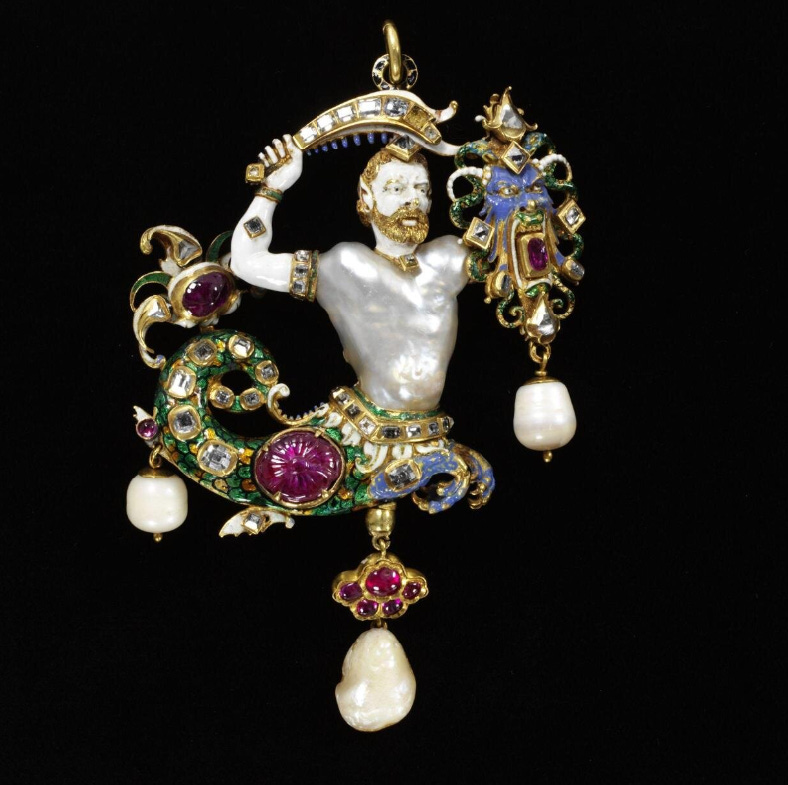
One of my favorite quotes about artists comes from Andre Breton. He said “The mind is wonderfully prompt at grasping the most tenuous relation that can exist between two objects taken at random, and poets know that they can always, without fear of being mistaken, say of one thing that it is like another.” What is applicable to poets is applicable to other kinds of artists as well. Here we have two examples. Sometime in the mid-nineteenth century an unknown jeweler in India was given this absolutely enormous baroque pearl, all knobbled and lumpy; this jeweler puzzled and pondered the pearl and in the end thought “you know what this looks like? A torso. A big muscly man’s torso.” So the jeweler made this brooch with the pearl in the center. Now it’s in the Victoria and Albert museum, having been brought back from India by Earl Canning, viceroy of India, in 1863. But the most glorious instance I’m aware of in which an artist said “that looks like something else” was made by Claes Oldenburg in 1977. His Mouse Museum is, basically, an enormous collection of random junk. But next to Mouse Museum is a building called Ray Gun Wing; and inside this building, Oldenburg has presented for display a different collection of junk—this time, the junk is all vaguely L-shaped. First there are actual toy ray guns, pistols, etc.—but then there are bits of metal, broken pieces of plastic or stone molding; suddenly everything begins to look like a ray gun; there’s no end to this metaphor; after looking at Ray Gun Wing a person begins to see other ray guns everywhere . . .


"Leighton was fond of making these pictures of medievalism which, to be sure, have the same sort of fan-service sourness that many of the Pre-Raphaelites indulged in: I’m being too forcefully invited to stare at the pretty girl, and I don’t like it."
Excellent article, but this made me pause and appreciate how different the the visual art-critical mind is from mine. It wouldnt occur to me to say this. It's a painting! Of course i'm invited to look arent I?