

Good art / bad art / non-art
Over the years, I’ve noticed a strange form of aesthetic criticism—strange to me at least. It happens when people encounter something that some artist made, and they are bewildered, disgusted, or otherwise put off by it, so they exclaim, “that’s not art!”
For a long time, I really didn’t understand why people say this. A while ago, I asked this question on Twitter.

One person suggested that “it’s not art” is a rather clichéd way of discussing any specific artwork—a much better tactic would be to say “that’s not artful”, with which sentiment I agree. Saying “that’s not artful” or “that’s not artistic” implies that there is, at least, a minimum standard of artfulness to which any artwork ought to adhere—but that it is possible for something to not meet that standard, yet still be counted as art.
When I clarified the impetus behind my original question, the conversation grew richer.

One person suggested that maybe there is an honorific element at play here. Calling something “art” elevates it to a plane above mere “design” or “craftsmanship”. This is a readily apprehended distinction: imagine a very well-made chair—would you call it art? Or is it just well-made? There is a line, in people’s minds, that once crossed imbues an object with the special characteristics of art, above and beyond what good workmanship requires. This line exists between classes of objects—hence the chair example above. But why is that so? Why is a very well-made chair not “art” in the same way that a very badly-made painting is? Similarly, why does a well-made painting count as “art” and not “craft”? Or put differently, what is it about Great Paintings that exists beyond craft?
Another person claimed that people say “it’s not art” because then they don’t have to engage in thoughtful critique of the artwork. They don’t have to grapple mentally with it; they can walk off with a wave of the hand and go look at a Vermeer or whatever.
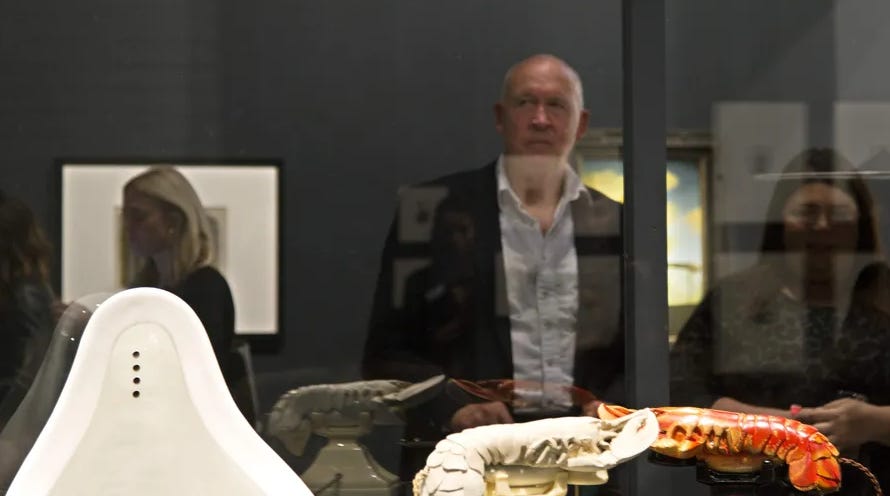
Then there was the person who said, simply, “because of Duchamp.” It’s true that Marcel Duchamp broke our ability to explain artistic creation with his readymades1—suddenly people were being forced to think about a question that they really didn’t want to face. It’s as if people said “art is supposed to be about a certain set of things, but your readymades, Mr. Duchamp, are not about those things. So by definition they can’t be art.” For most people, a trip to the museum or gallery is not meant as an occasion to engage in philosophical debate about the nature of artistic creation. Confound it, we just want to look at some pretty pictures!
With Duchamp and the readymades, with cubism, with Dada and surrealism, with abstract expressionism—with the whole apparatus of avant-garde thought in the visual arts of the twentieth century, in fact—came a fundamental inability to even talk about a particular artwork’s artistic merits. How can you say that Fountain is a good, or a bad, readymade? What scale would you use to differentiate between a readymade by a first-year art student, and one by Duchamp himself? Are the drip paintings of Pollock, or the color fields of Rothko, good or bad examples of their styles? One person commented on the Twitter question above by saying that “it’s not art” “is easier because it tends to reject the modernist (avant-garde) frame completely.” Annoyed with all the baggage of the avant-garde, all the isms and artist statements, the poses and philosophical justifications of this or that artistic movement, some art lovers simply say, “y’all have got the issue all mixed up. Art isn’t about that stuff.”
All of these explanations are compelling, and I think I’ve been broken on the floor this time; when I took to Twitter I was prepared to defend my long-held belief that “it’s not art” is a lazy / foolish way of tackling the problem of aesthetic complexity, but now I’m not so sure. I’ll probably still ask people to clarify when they say that something isn’t art, but I won’t be as prickly about the issue. Maybe we need a new category in which to place the efforts of Duchamp et al.—then we can say “that’s not art, that’s meta-art” or something similar.
MISC.
If you’re looking to read more about how we view and interpret pictures, James Elkins is your go-to. He wrote a series of essays for the Huffington Post, about close viewing and art, which are well worth your time. He also wrote a number of books about art history, perception theory, and visual stuff in general, three of which I reviewed here.
The most famous being Fountain (1917), which is pictured above, but Duchamp’s output also includes Bicycle Wheel (1913), which consists of a bicycle wheel and fork mounted on a footstool, and L.H.O.O.Q. (1919), which is the official title of the notorious goateed-and-moustached Mona Lisa.
I was brought up solidly within the Conceptual milieu where Duchampian thinking was de rigeur. All of the avant-garde mediums and practices were celebrated and taught. So if and when I encountered something new the thing to ask was not is it art, but what does it do?
I think it would be a mistake to try to relegate the readymade and its many relations to some other category. The point of Duchamp’s intervention (unless you fall into the camp that thinks Fountain was just a stunt) was to throw into question what people thought they knew about art, and to force them to contend with art’s philosophical bounds and the constraints of bourgeois “good taste.” When people these days say “that’s not art,” it’s often because their understanding of art history is limited -- they have no frames of reference for processing why a bicycle wheel on a stool should be considered art, much the same way I have no frame of reference sometimes for certain kinds of avant-garde music or theoretical physics. Most of the time I know better than to dismiss what I don’t understand, but I’m afraid lots of people have a much lower tolerance for anything that makes them feel uneducated or alienated. As I tell my students, “I don’t like that” or “I don’t get it” is a much more accurate way to respond to such work, and it opens the door to actual understanding (if you’re open to the explanation).