

The Carnival is Over (Dead Can Dance, 1993)
Dead Can Dance’s Into the Labyrinth is a messy record. Sprawling all over and lacking focus, it displays unflatteringly the differences between the songwriting styles of Lisa Gerrard and Brendan Perry. Their best work was behind them when they made this record; and I say this despite knowing that Into the Labyrinth is by far their most commercially successful album. On it they basically invented the genre of neoclassical darkwave, which, if you aren’t familiar with it, can best be described as goth music that sounds like it’s from Shakespeare’s time. Lisa Gerrard sings all over this album in what sounds like either Eastern European funeral chanting or an off-brand version of the kind of meaning-free mumbo-jumbo that Liz Fraser invented for Cocteau Twins.
It’s a nice sound overall, but I miss the sense of gloom and drama, the foreboding, the creepy-cemetery vibe of albums like Spleen and Ideal or Within the Realm of a Dying Sun. Even after they moved past their roots and started exploring new musical territory they were still able to tie a set of songs together on The Serpent’s Egg, a much more vigorous and interesting album than Into the Labyrinth. After this record the duo would make only one more superlatively good song: Spiritchaser’s “Song of the Stars.” These days, Dead Can Dance is still trudging along somehow, surfacing every few years either to schedule a tour and then cancel it for health reasons or to release bajillions of live albums just like King Crimson does.
Yet there is a tendency, in the albums Dead Can dance released right around the beginning of the nineties, for the music to flow along nicely as a collection of pretty sounds and then for Brendan Perry to drop a song of such utter perfection that it cancels out all that had previously been stated, and the album, floundering, has to figure out its own purpose again. This occurs with “In the Kingdom of the Blind the One-Eyed are Kings” from The Serpent’s Egg and “Fortune Presents Gifts Not According to the Book” from Aion. On Into the Labyrinth, the effect is achieved with the song under consideration today: “The Carnival is Over,” a stunning jewel of a song, the best piece on the record and, maybe, the best single song of Brendan Perry’s career. It’s also terribly sad, as we shall see.
It begins with some minor-key strings of the type that are often used as a cue for gloomy feelings in the movies. A few moments later the sad strings are joined by a slowly-plucked medieval lute or guitar, and then a higher-pitched synth-woodwind figure, accompanied by sleigh bells, rounds out the song’s sonic environment. At 1:17 Perry starts singing. His voice seems strained a little, with just a bit of vocal fry here and there (he’s a good singer, but he often has trouble with long notes at soft dynamics). He sings something about flowers and a thunderstorm.
Outside the storm clouds gathering
Move silently along the dusty boulevard
Where flowers turning crane their fragile necks
So they can in turn reach up and kiss the skyThey’re driven by a strange desire
Unseen by the human eye
Someone’s calling
What’s this all about? Flowers bending towards the sun, a storm cloud passes a dusty street; it’s all very evocative of . . . something . . . and it sets the tone of sad reminiscence which characterizes all that follows. The woodwind / string accompaniment plays swirling arpeggios as Perry sings the next verse.
I remember when you held my hand
In the park we would play
When the circus came to town
Over here
This sounds like a memory of childhood, an idyllic time; and the song is part of a long tradition of rock songs which reference a playground from the narrator’s early years. Notable examples include Dan Rossen’s memory of his dead father in “In Ear Park” and John Lennon’s more overtly idealized recollections in “Strawberry Fields Forever.” Part of the appeal of these kinds of songs is that nearly everyone can relate to them. All adults were children once. When we think of the cares and troubles of adulthood we remember that when we were five years old there wasn’t anything bothering our happy play (except, perhaps, bedtime). In this instance, though, the musical accompaniment is telling us this is a sad memory. Why is it sad? The music seems to be working against itself with those cheerful, playful arpeggios atop those gloomy chords.
Perry does something interesting with this verse. The first line “I remember when you held my hand” is a concrete image and a timeless one: this could have happened to him many times in many contexts, it doesn’t matter. But then: “In the park we would play”—now the imagery is becoming less universal, more specific, more evocative of a particular set of moments in the speaker’s memory. At the same time the field of view is increasing. “When the circus came to town”—now we’re talking about one singular event. The speaker’s focus has telescoped, in these three lines, from a generic childhood to a precise instant, while also expanding from his one held hand via a city park to the entire town and even to the traveling circus which had to have come from somewhere out of town, therefore intimating to him the reality of a broader world—this song is about a dawning realization of the vastness of existence. The “you” addressed in the song’s lyrics could be a parent or other guardian but I like to think of it as a fellow child.
The high F in the word “here” is the highest pitch Perry sings. This two-word line is a masterstroke. It’s the poetic equivalent of what cinematographers call a whip pan: our vision is directed, in an instant, from the dusty present to the vivid yet distant past in which the speaker and his companion watched the circus pack up and leave. Notice that before “over here” the narration is in the past tense. In the next verse, it’s all in the present tense:
Outside the circus gathering
Move silently along the rain-swept boulevard
The procession moves on, the shouting is over
The fabulous freaks are leaving town
The synth melodies from earlier have become more lilting and ornamental at the end of every other line, further increasing the contradiction inherent in the music. I love the poetic intensification which happens in the second line of this verse. “Procession” is such a left-brain word; it names a particular thing and places our impression of it into an easily understood category. “Shouting” is the opposite: it fills the mind with senses and sensations without explaining them or tying them to a specific type of event. This line is an example of the kind of poetic parallelism found in the Hebrew poetry of the Bible. Together, these two words communicate the entire concept of a traveling circus: the parade, the carnival midway barkers, the sideshow, the people who have come to see the sights. But the next line’s image of “The fabulous freaks” is even more evocative, filled with deep wells of meaning.
For some reason I’m reminded of the cover image from Tom Waits’ album Swordfishtrombones. On it Tom Waits looks like the sort of person who would run away to join a circus and maybe already has; he’s in the company of a dwarf and a strong man, and he’s giving us a “these are my kind of people and we are so superior to you” sort of look. The life of a circus performer is not particularly great. It’s full of upheavals, difficulties, disasters, and the sort of desperate camaraderie that only exists among outcasts. Yet there is a romance about that life: adventure, unpredictability, an opportunity to see the world and to have lots of fun, to be the object of a sort of love or admiration simply by virtue of one’s existing in the world: a dwarf or bearded lady doesn’t even have to practice to do their job well. Still, the circus is a place of aching sadness.
They’re driven by a strange desire
Unseen by the human eye
Someone’s calling
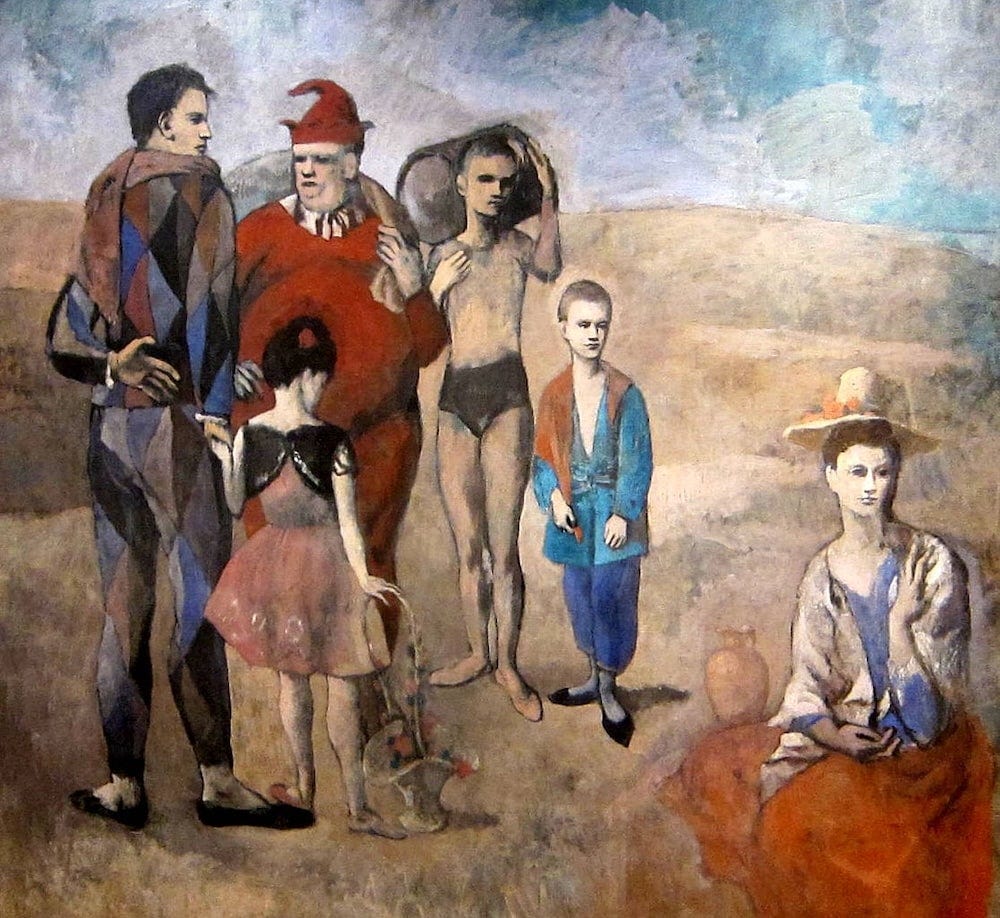
This “strange desire” might be simply the promise of more crowds and ticket sales at the next town; but, when considered in light of the “strange desire” of the flowers in verse one which strain towards the light, I wonder if what is meant, here, is the universal desire to thrive and flourish. Circus people can’t do that if they stay in one place, though; unlike flowers, they are always pulling themselves up by their own roots and moving away. I think this is part of what makes circuses so fascinating, and also so sad. Think of Picasso’s Rose Period paintings of circus people (the largest and best of which is illustrated at the top of this essay): here are a bunch of misfits and outcasts, bound together by the trials of the road; theirs is a tough hard life and all they have to rely on is each other, and weak though that support maybe it is fiercely loyal. It’s hard to imagine such a life. Perhaps the closest most of us have to it is the military life, in which people are made to move around at the whim of the government and a distinct culture develops thereby. But at least the government gives out a good pension to retired soldiers. In the circus, what happens when an acrobat’s body wears out and they’re just too old to work anymore?
The music twists and whirls. Brendan Perry sings the song’s title and then the instruments drop out except for those string chords and a triplet figure on a flute.
We sat and watched
As the moon rose
For the very first time
He ends the song with these three spoken lines. And now I understand this song’s true interpretation: it is about a child’s first encounter with the fleetingness of beauty. On this day so long ago he remembers three things: the presence of his friend, the departing circus, and the rising moon; and they all work together in him to reveal to him something of the true beauty that exists underneath all the phenomena, but also of the tragedy that twines about all earthly beauty: it always fades.
I don’t remember the first time I ever noticed the beauty of the rising moon. But I do remember other times I first encountered some particular species of beauty: the sparkling on freshly-fallen snow; being able to recognize particular patterns in the stars; the sun, pale behind blowing fog. These things remain objectively beautiful every time I again see them but the subjective wonder I felt at seeing them for the first time has long passed.
And I remember being five or six years old and playing with a little girl under a bush with big bunches of white flowers on it, and becoming aware, there with her, of something true about beauty. I haven’t spoken to this girl in decades. What makes this song so sad, I suppose, is the same thing that gives me a melancholy feeling when I think of her: not only is the beauty in the world so often elusive, fleeting; but also the freshness of newly-discovered beauty fades away. We see something amazing for the first time and part of us knows that years from now we will be so familiar with it that we won’t see it as amazing anymore. The carnival always ends, eventually.
However—maybe it is good that this is so.
The books or the music in which we thought the beauty was located will betray us if we trust to them; it was not in them, it only came through them, and what came through them was longing. These things—the beauty, the memory of our own past—are good images of what we really desire; but if they are mistaken for the thing itself they turn into dumb idols, breaking the hearts of their worshippers. For they are not the thing itself; they are only the scent of a flower we have not found, the echo of a tune we have not heard, news from a country we have never yet visited.
So says C. S. Lewis in his sermon “The Weight of Glory.” Lewis is trying to explain that all the beautiful and good things of this temporal existence ought to point us to the ultimate beauty—the beauty of God; and to serve to whet our appetite for the things of God, which will prepare us for heaven. Brendan Perry sings of knowing that the earthly beauty will fail, knowing that there will only ever be one “first time” for the moon to rise and that the carnival will be over sooner than we wish. But there is a place prepared for us in which the beauty will not fade. Could it be that all the corpus of art and music and literature only has value in pointing us toward that place? Perhaps.
the unearthly beauty of so much of the music of dead can dance can’t help but direct the soul towards God. there’s also something about the way perry gets so close to the edge of absolute cringe that carries him over to the sublime. he’s always on a high wire