

The Mocking of Christ (Matthias Grünewald, 1505)
A chiastic meditation
Even though I’m fascinated by this painting and want to tell you how much I love it, it could be that I don’t know what I’m talking about. Forgive me, please—I have not actually seen this picture, not in person at least; I am simply too poor to visit Munich’s Alte Pinakothek and look at this painting by Grünewald, much as I’d like to. I can’t even afford to drive to Dubuque, Iowa, and look at the Grant Woods, because I spent all my disposable income on books. I’m sure that there are aspects of this picture which I will not be able to see because of my not having taken the trouble to look at it in real life. I will not be able to comment on its physicality, its existence as an object, the feeling of looking at a work of art which was made more than five hundred years ago. All of that is lost to me.
Does it seem noteworthy to you that there are so many funny-looking people in the northern painterly tradition? In picturing the people around them as homely, plain, or just plain ugly, the northern painters were being honest about the world around them and also deliberately pushing against the ideal of physical beauty propounded in the Mediterranean countries from the time of the Greeks forward to the Renaissance. But I can’t be sure about that “deliberately”—all I’m going off of is a hunch. I think it’s an important thing, though, to be aware of the lie of beauty: the idea that there is a standard of how people are “supposed to” look, which is a very unchristian idea. “Charm is deceitful and beauty is passing,” says king Lemuel’s mother;1 and lest we forget, Christ himself is described in Isaiah as “having no form or comeliness or beauty that we should desire him.”2 A fixation on physical beauty is the worshipping of an idol. It’s not too much to say that the history of western art south of the Alps has been a relentless pursuit of that idol and that the northern tradition constitutes a needed check to that pursuit.
Consider, though, that there might be another reason why Grünewald painted these specific people as being rather less than gorgeous. Consider what they are doing. I saw this painting as I was flipping through a book by Charles Cuttler called Northern Painting: from Pucelle to Bruegel which I had picked up at the local library book sale. There it was: and it was one of those times when I was immediately arrested, compelled to take a close, long look. What did it for me was the raised fist of the person standing right behind Christ. That fist, curled up, twisted unnaturally, about to be pounded with vehemence onto the back of Christ’s head, is a metaphor, of course, for all the blasphemy, the mockery, the reviling that happened on that night in Jerusalem when Jesus was dragged from the sham court of Pontius Pilate and hauled off towards his final humiliation on the cross: and it’s also a metaphor for the weight of all the sin that drove Christ there. It’s a perfect element in a perfect painting: a beautiful painting, despite how full it is of ugliness—not the least of which is the ugliness of Grünewald’s cast of supporting characters.
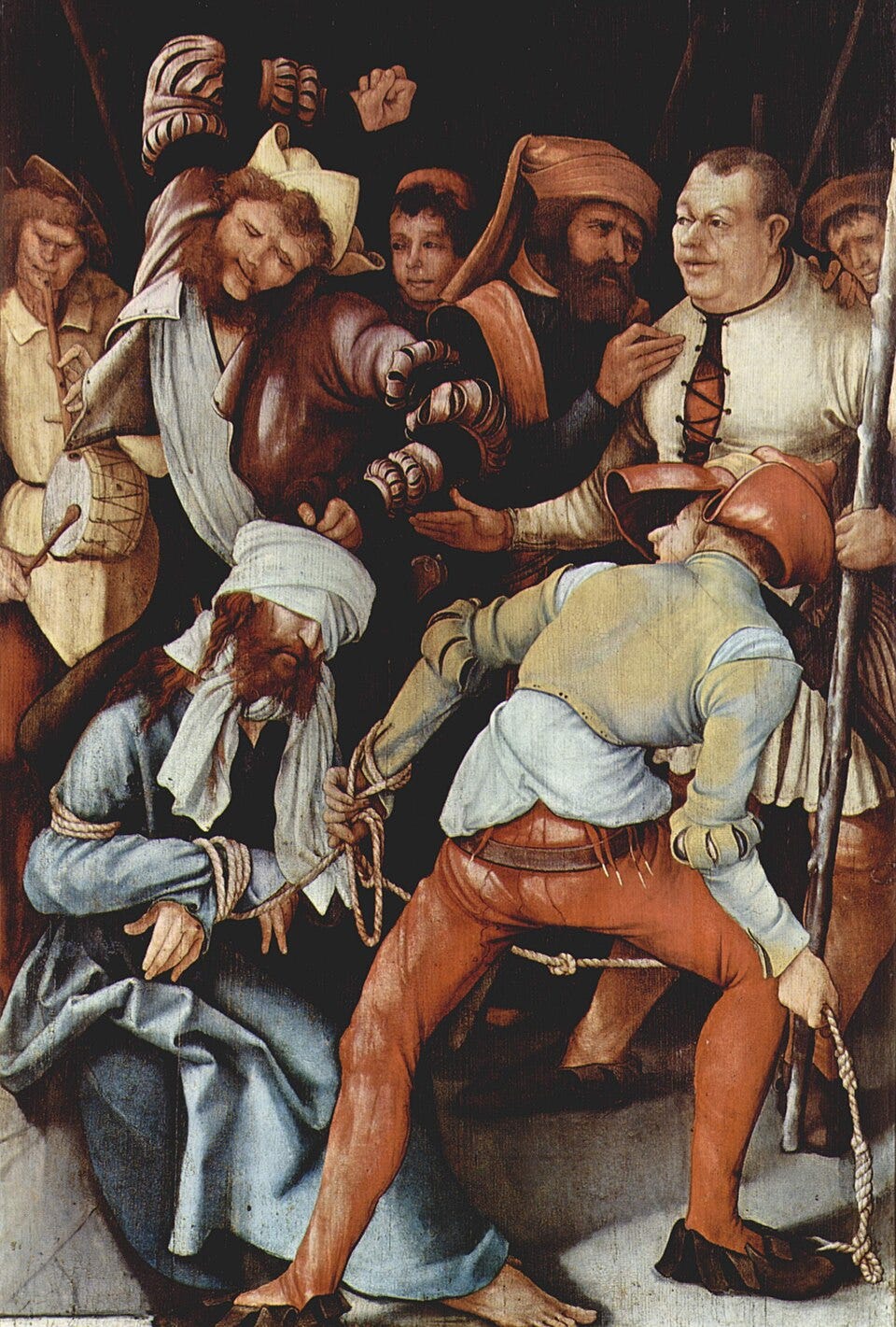
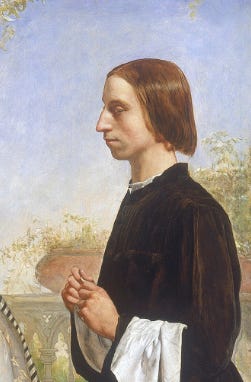
Behold the beauties offered, here, for our inspection and admiration. We see a guy with a complicated hat tugging Christ with his rope. We see a stupid-looking official with some sort of staff, a gothic dope even more splendid than the one in Millais’ The Pot of Basil;3 he stares, mouth open, past the maker of the universe with unseeing eyes blinded to the reality of Christ’s identity.
At the extreme left we see a beetle-browed musician. This guy is worthy of a closer look on his own. He’s crammed into the side of the picture, almost as if he’s trying to force his way into this scene of malicious merriment, raising a ruckus with his oddly-fingered pipe and drum. He reminds me of the line from Sarah Josepha Hale’s “Mary Had a Little Lamb”: “It made the children laugh and play to see a lamb at school.”
Her “and play” has always struck me as quite appropriate: I’ve seen the same sort of behavior in my own kids. As soon as they see that there’s been any kind of breach of decorum or out-of-the-ordinary, unusually merry happening—especially if it seems sanctioned by the adults in the room—they will decide it’s time to get wild. Always, if the restraints are loosened, the unruly sinfulness of our hearts wants to get even more unruly. And this is what the piper is doing here: he sees the rowdy nature of what’s happening around him and he decides to add to the rowdiness. His inclusion in Grünewald’s painting gives the scene an appropriately uncouth, somewhat disgusting quality: like a frat party turned embarrassingly nasty.
Another guy right in the middle of the painting, a distinguished-looking old man in a fancy hat, seems to be trying to restrain the proceedings. He gestures towards the official and expresses sadness with his eyes. Perhaps he is meant to be Joseph of Arimathea or Nicodemus, protesting against the humiliating treatment Jesus is receiving.
But he gets shoved aside. The dumb official isn’t interested in hearing the old man’s objections. He cares more about letting the course of events keep rolling. He reminds me of Pilate himself, who I’ve always seen as being a rather un-leaderly ruler. Pilate could have easily declared a firm “No” to those who wanted Jesus crucified. But he didn’t, and he thus exemplifies the kind of inept politician who won’t do the hard job of standing for what is right when their approval rating is on the line.
Come back to the painting with me. It is arranged vertically. This is what we see from bottom to top: first there is a relatively empty strip of ground and feet; nothing much is happening here. Then the chief tormentor’s rope snakes across the painting about one quarter of the way to the top. The first face we come to is Christ’s; as we continue to travel up the picture we encounter the face of the man with the rope, and then, all at nearly the same level, the six other people who crowd along the top edge. But above them there is an empty blackness punctuated only by that terrible and obscene curled fist. The curve of the index finger is the beginning of a magnificent curlicue, coiling around the man’s clenched knuckles, through his elbow, across his shoulders, and on to his left hand, clenched around a lock of Christ’s hair which he is gripping to steady our Lord and Savior’s head in preparation for his mocking blow. And Christ just sits there. Resigned to the situation. “He was oppressed and he was afflicted, yet he opened not his mouth.”4
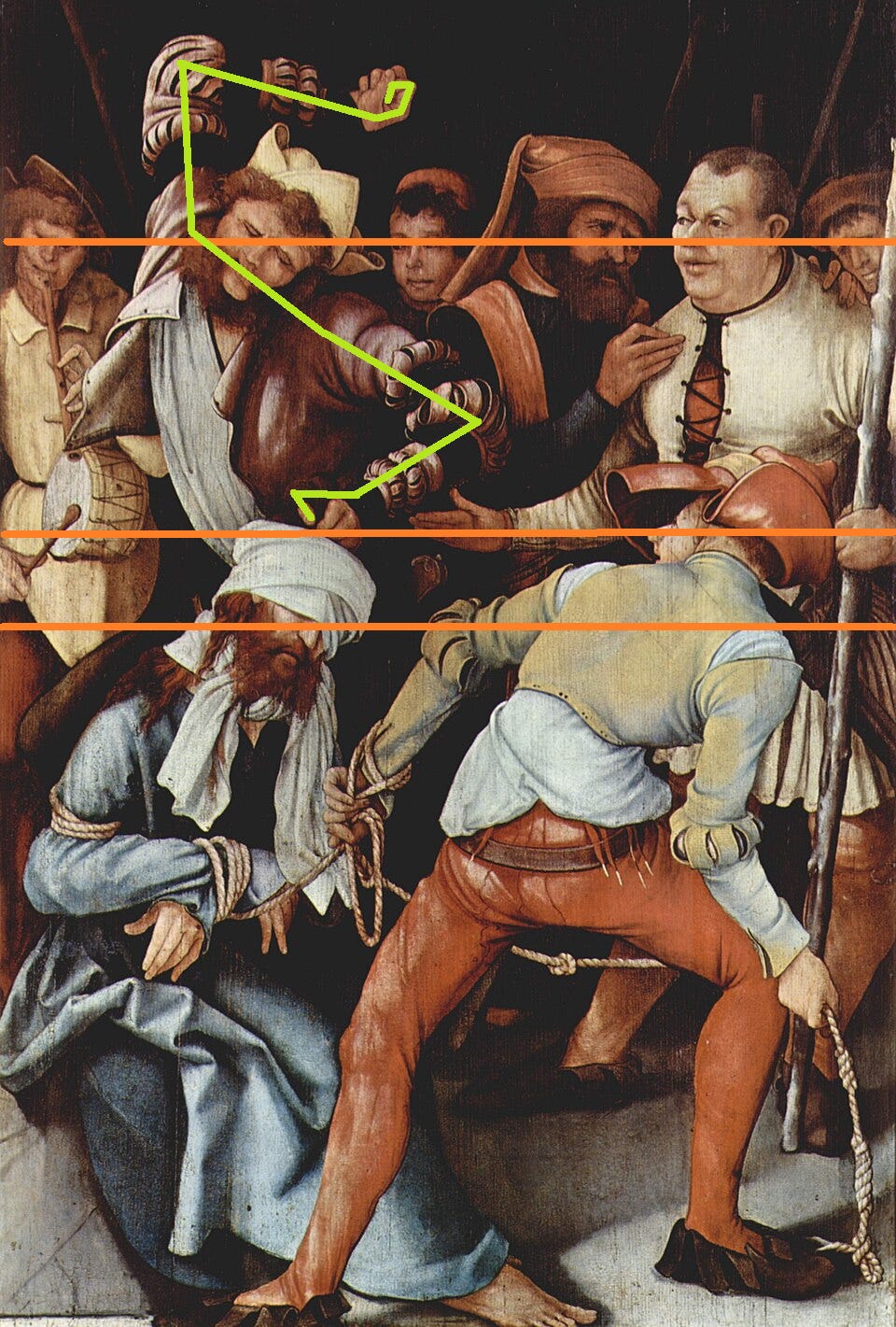
Do you see how, in Grünewald’s version, he also opens not his eyes? It’s noteworthy that everyone’s eyes can be seen in this picture—everyone’s, that is, except for Christ’s. Is Jesus refusing to acknowledge the atrocity being committed here? Is he “looking the other way” at the blasphemy being perpetrated? On the cross he prayed “Father, forgive them, for they know not what they do.” The covering of Jesus’ eyes in Grünewald’s picture reminds me of one of my favorite passages in scripture: the story of Balak and Balaam. Balaam was a magician and prophet hired by Balak, king of Moab, to pronounce a curse on the children of Israel as they camped by the Jordan river. But Balaam wouldn’t do it, having been warned by an angel not to depart from the blessing which he instead was told to speak. In his subsequent prophecy, Balaam has this to say about God: “He has not observed iniquity in Jacob, nor has he seen wickedness in Israel.”5
Every time I reread it I’m astounded at the depth of God’s forgiveness in this passage. The parents of these children of Israel flagrantly violated God’s injunction not to worship him with images when they built a calf idol and called it their God. These Israelites spent nearly the entire journey to Canaan acting like whiny kids on a road trip, complaining and grumbling to Moses about their lack of luxuries despite their having seen the miraculous providence of God in getting them out of slavery. God knows they will fail to adhere to his laws almost as soon as they cross the Jordan river into Canaan. Yet he holds no grudge; he forgives them. “I have not seen iniquity in Jacob.” “Grumbling? Idolatry? I don’t know what you are talking about.”
Proverbs 31:30.
Isaiah 51:2.
Isaiah 53:7.
Numbers 23:21
.