

1: HEARD AT A MAGIC SHOW
And now, ladies and gentlemen, and children of all ages! Prepare to be amazed, astounded, shocked, and stupefied by my next illusion—the Chinese Mystery Box! Never in your life will you have been so surprised as you will be upon seeing this amazing feat of legerdemain. I would ask that those who are of a sensitive disposition, who are easily frightened by inexplicable mysteries, and who are susceptible to fainting caused by overexcitation of the nervous system to please leave the room at this time; also, if you are in the company of small children who might become easily started or distressed, you are hereby advised to remove your children from the hall, as the events which are about to transpire before your eyes are of such an unexplainable and confusing nature that even those who are in possession of the most stalwart and skeptical of constitutions may begin to question their ideas of the basic fundaments of the universe upon seeing what will shortly transpire here upon this very stage. Indeed, this performance has been undertaken in the presence of some of the most enlightened and learned men of science, exemplars in their disciplines and with unimpeachable reputations for level-headed rationality in the face of the most confusing phenomena of the natural world; and even they have confessed to being baffled and flabbergasted by what they saw, and are at an utter loss for an explanation of its mysteries. What you are about to see is no mere parlor trick, no cheap sleight-of-hand suited for a children’s birthday party; no indeed, ladies and gentlemen! I wish as well to inform you all that what you are about to witness is a conjuration with an ancient and storied pedigree. An illusion of this kind was first recorded as having been performed for the legendary Emperor of China, Qin Shi Huang, two hundred years before the birth of Christ. The secret of its execution has since been passed down in an unbroken chain from one master magus to the next, throughout all the subsequent ages of history; and the true explanation of its secret has been jealously guarded during that entire time. It is said that murders have been committed for its sake, and that men have been driven to madness in an attempt to unlock the mysteries of its performance. I have been told on the highest authority that none other than the great Houdini was reputed to have offered the sum of five hundred thousand dollars for the privilege of being initiated into its secret; but he was refused. Before we begin, if I could have two volunteers to come up to the stage and examine this oaken box which I have set upon this table. You will note, gentlemen, that it is of a solid and sturdy construction. If you please, gentlemen, tap or knock the sides with your fist—note how solid they are! Now, if you will, please come around to this side and open the top of the box. Note that there is nothing on the inside. I will tip the box over onto its side and show the inside to the assembled audience. I believe you would agree that there is nothing at all in the box? And now, please, gentlemen, if you could assist me in lifting the box up and off from the table; notice that the base is of a comparably solid construction to the sides of the box. I wish now to direct your attention to the table upon which the box has been resting. If you will allow me, gentlemen, to place the box to the side, on the floor; we will give the table an appropriately thorough examination, merely for the purpose of allaying any suspicion. I will simply remove the cloth which covers the table. And now if I could ask a young lady or matron from the audience, one who is familiar with the domestic arts and a competent judge of fabrics, to come forward and closely inspect the quality of the linen cloth which covers the table. If you please, madam, run your fingers over the cloth and feel its quality. It is of fine workmanship, with no rips or tears or holes; it can be trusted to maintain its structural integrity under strain. Now if you could, please, gentlemen, pay very close attention to the construction of this table. Note how it, too, like the box, is made of fine solid workmanship; it does not come apart at all, and note also that there are no secret drawers or compartments anywhere on either the table itself, or on the legs upon which the tabletop is supported. I would ask you to very carefully note the thickness of the tabletop; be mindful that it is both sufficiently strong to hold the weight of the box, yet it is inconceivable that there is any possible space within the tabletop to conceal any sort of complicated machinery or apparatus. Just to be sure on that last point, gentlemen, I will ask that you allow me to drill a hole through the tabletop, to allay any suspicion that there might be something, some sort of mechanism, concealed therein . . . [Editor’s note: this sort of patter continued in the same style for a considerably long time; I left out of impatience before the trick was actually performed.]
2: FRAME-TO-ART RATIO
Have you ever seen a painting with a frame so flamboyant, so ornate, so excessive in its decoration that it detracts from the aesthetic experience of looking at the picture it encloses? These days it’s fashionable for frames be very narrow and unobtrusive, assuming they are present at all: much contemporary art dispenses with the frame altogether. But in earlier times it was common for the frame itself to be an object, if not of art, then at least of artistry—that of the woodcarver, whose skill at decorating frames is, in some instances, of more interest than the skill of the painter who made the art which the enveloping frame overshadows.
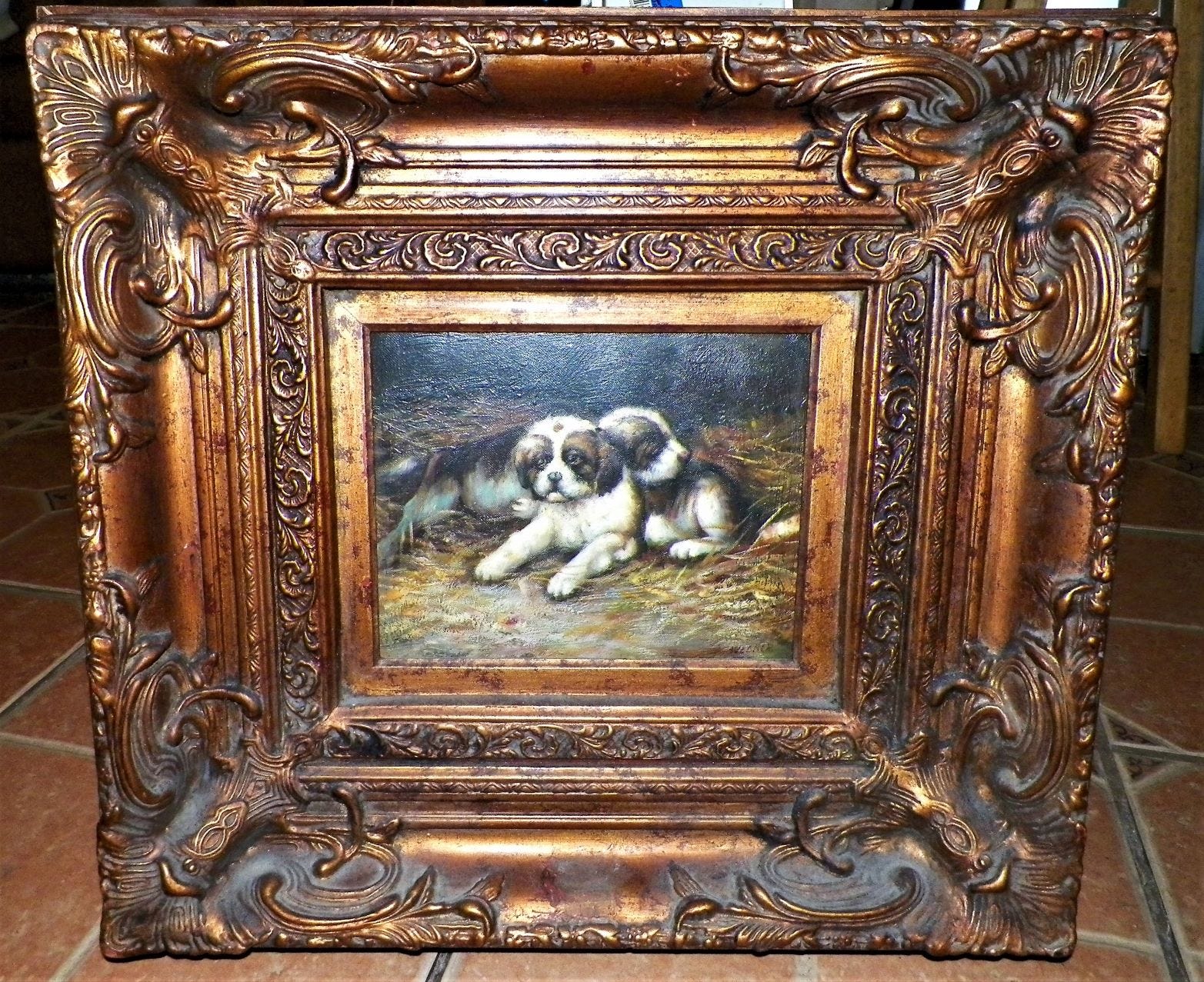
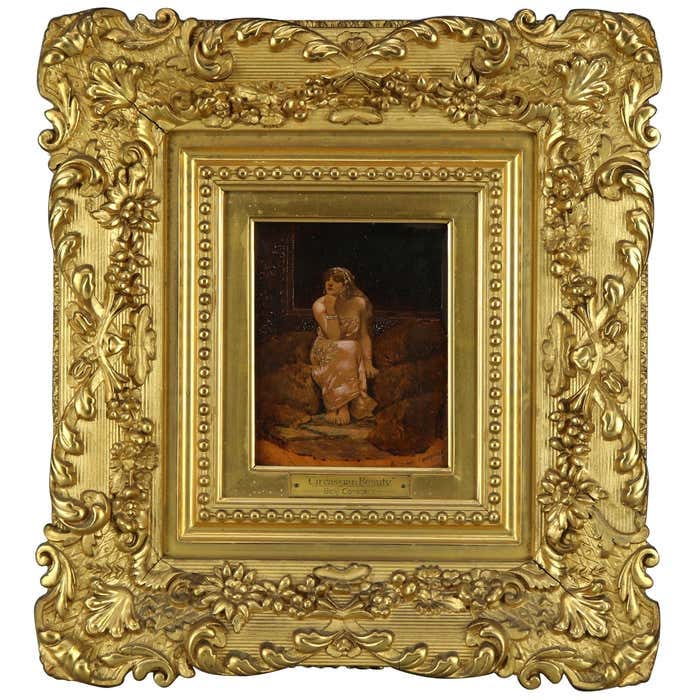
The above painting (found on this antiques chatroom) has one of the largest frame-to-canvas ratios of any work of art I’ve ever seen. By my calculations the total area of the frame itself is 27.89 square inches1 but of the painting alone, only 5.25 square inches, yielding a frame-to-art ratio of 5.31 to 1. Excessive, say you? What about this one: the frame area is 41.315 inches and the picture is only 5 inches; that’s a frame-to-art ratio of 8.26 to 1. I found it on this auction site. It sold for $10,000, which comes out to $1079.62 for the painting and $8920.38 for the frame.
The ultimate would be if there were no art at all, just a massive frame, the four sides of which would each take the form of right triangles touching at their 90-degree angles, with the painting the size of an infinitesimally small mathematical point directly in the center. What would be the frame-to-art ratio of something like that? Infinity to 1? 1 to zero?
Or maybe the ultimate would be an assortment of frames displayed for their own aesthetic value, as described in Italo Calvino’s novel If on a Winter’s Night a Traveler:
In one corner of a wall there are a number of framed photographs, all hung close together. Photographs of whom? Of you at various ages, and of many other people, men and women, and also very old photographs as if taken from a family album; but together they seem to have a function, not so much of recalling specific people, as of forming a montage of the stratifications of existence. The frames are all different, nineteenth-century Art Nouveau floral forms, frames in silver, copper, enamel, tortoiseshell, leather, carved wood; they may reflect the notion of enhancing those fragments of real life, but they may also be a collection of frames, and the photographs may be there only to occupy them; in fact some frames are occupied by pictures clipped from newspapers, one encloses an illegible page of an old letter, another is empty.
3: FRAME AND NON-FRAME INVERTED
What little I’ve heard of K-pop gives me the impression that although there is probably a kernel of goodness in there somewhere—since I believe that there are very few genres of art which are irredeemably bad—I can’t, at this time, perceive what it might be. Like every other parent of preteen girls I was driven nearly to distraction by having to hear that one song from KPop Demon Hunters over and over and over a few months ago. Before that I don’t think I’d ever actually listened to any K-pop at all, yet I was well aware of it as a visual and cultural phenomenon. I had heard all the stories of obsessive fans, kids forced to get plastic surgery, terrible working conditions, corruption and scandal; and I had seen the K-pop racks at various retail establishments and been entranced by the multitudinous styles of packaging in which the albums came. No bland jewel cases here—not even those cardboard sleeves which enclose Keith Jarrett’s ECM albums or Wilco’s Yankee Hotel Foxtrot. No: these albums came with elaborate packages enclosing, at times, sets of stickers and postcards, collectible posters, books even. For a while I was seriously considering plunking down a few hundred dollars and buying a pile of K-pop albums just for the packaging. But while I was getting my mind melted with excessive replays of “Golden” I realized something: K-pop is all frame. There’s not much of value in the music and I’m not sure there is meant to be—but how it is packaged is fascinating. And I don’t mean just the CD cases. The bands themselves: the gorgeous boys with their perfect complexions; the fancy outfits; the elaborate stage shows. All of these things are what would have been considered incidental to the music in most other genres. Or maybe not; since the Beatles showed up on Ed Sullivan in 1964 pop music has been continuously packaged—framed—in ways designed for visual appeal, with only a tangential reference to the actual music.
Theodore Gracyk comments on the tendency of rock musicians to frame their activities in a way which doesn’t quite do justice to the musicians’ actual working lives. “Pick up an illustrated history of rock music,” he writes. “Again and again we see two sorts of images. First, the posed formal portrait of the musician holding a guitar or seated at the piano. Second, the performer on stage, usually in the throes of passion, in live performance. What we seldom see, in photographs or videos, is the reality of the creative process.”2 I’m appreciative of Pink Floyd’s documentary film Live at Pompeii because it does, in fact, contain large stretches of footage of the band members in the studio. There they are, working on overdubs. Twiddling knobs at the mixing desk. There’s Roger Waters with headphones on in a little glass room talking to the engineers via microphone. This is the reality of the rock’n’roll lifestyle—not the jumping around on stage, moody romanticism, bite-your-lip type of stuff.
It is more glamorous to show the rock musician being moody than it is to show them logging boring hours in the studio. But K-pop’s framing is something different. K-pop is selling the frame as the art. I have a suspicion that the reason K-pop music exists at all is to push the posters and booklets and online parasocial engagement and Korean soft cultural power—not the other way around. But I’ll have to do more research on that point to be sure.
4: EXCELLENCE VERSUS ITS APPEARANCE
Here’s a piercing offhand observation by a. natasha joukovsky, recounted in the context of a visit to her dry cleaner in Georgetown.
I only started coming here last year, after my former preferred establishment changed ownership, professionalized its storefront, and ruined my favorite pants. This place at minimum looks like a fire hazard, if not a candidate for Hoarders. The customer service is . . . not a priority. They do immaculate work. They’re forever running behind precisely because they’re so good at what they do, because they take pride in their art, and I appreciate that; revere it. Everything about the place—the attitude, the environment, the results—speaks to an ethos I admire intensely: of striving for excellence over its appearance, of doing so even to the point that the latter is almost necessarily sacrificed.
The appearance of excellence instead of the real thing: is that not also a kind of frame? A frame can indeed look pretty, though if it draws our full attention from the badness (or the goodness) in the art then all it’s doing is distracting us. And though a crisp clean social-media-post-worthy store interior looks professional, isn’t that also just a kind of frame? This reminds me of another discussion of the appearance of excellence contrasted with the real thing:
The first and roughest drawings I put in very smart gilt frames to show them off; but as the copy becomes more accurate and the drawing really good, I only give it a very plain dark frame; it needs no other ornament than itself, and it would be a pity if the frame distracted the attention which the picture itself deserves. Thus we each aspire to a plain frame, and when we desire to pour scorn on each other’s drawings, we condemn them to a gilded frame. Some day perhaps “the gilt frame” will become a proverb among us, and we shall be surprised to find how many people show what they are really made of by demanding a gilt frame.
This is from Emile; or, On Education (in the passage where he’s talking about teaching Emile how to draw) by Jean-Jacques Rousseau—and I’m of the opinion that the old fool might just be right this one time.
3': FRAME AND NON-FRAME INTERTWINED
All of the pictures in Rothko Chapel have no frames. Or: Rothko Chapel is the frame for all the pictures housed therein.
A church or chapel is supposed to be a place where one has a religious experience; that could, perhaps, explain why visitors to Rothko Chapel are so often moved to tears. “It is likely,” James Elkins writes, “that the majority of people who have wept over twentieth-century paintings have done so in front of Rothko’s paintings. And of all Rothko’s paintings, people have been moved most by the fourteen huge canvases he made for the chapel that now bears his name.” But when Elkins himself went to look inside Rothko Chapel he didn’t feel like crying: “I was tired from looking so long at so little.”3 The people who do come to Rothko’s Chapel and end up crying are, I suspect, dong so because of the framing of the chapel. This is a religious place. There are copies of the world religions’ holy texts in the front lobby. The pictures, associated as they are with the concept of religion, take on a religious meaning. If people don’t cry as much in front of the Rothkos found in museums around the world, it could be because the museum / gallery frame encourages a dispassionate, emotionally detached aestheticism. Would the Rothko Chapel paintings motivate viewers to tears if they were dispersed across a random assortment of museums? Would a different grouping of Rothko’s paintings be as capable of inducing tears if they were in the Chapel instead of the ones in there now? What if it were Pollock Chapel or Franz Kline Chapel: would there still be all the crying?
2': KINDS OF FRAMES
Mostly, frames serve two purposes. Sometimes they are meant to enhance our experience of the art. Sometimes they serve as a boundary between the artwork and everything that is not the artwork. In the former category I’d put the rock posturing we’ve examined, the magician’s stage patter, and the carven and gilded frames around old masterworks. This last category can easily bleed into kitsch. Some wag once said there is a difference between symbolizing beauty and representing it. The fancy wooden frames despised by Rousseau would fall into the category of symbolizing. Or maybe they act like highway signs, alerting us to the presence of the beautiful artwork which they enclose the way a no passing zone sign alerts us to the road conditions.
The second purpose of frames, that of boundary, is more interesting. I’d argue this is what is happening with the whole white cube ideal of the modern gallery or museum: the gallery / museum is presented as a set-apart space, a sacred space. This is the real reason why contemporary paintings rarely have frames. They don’t need to be separated from the sacred space. They are an integral part of it. Contemporary artworks don’t have frames for the same reason the Sistine Ceiling doesn’t have a frame.
ENTIRELY UNRELATED
My pastor was recently talking about chiasms. He said they had the same shape as cheeseburgers: A-B-C-B'-A' is the same as bun-condiments-burger-condiments-bun. I love chiasms and have stated my admiration of them more than once; inspired by his comments, I wrote this poem.
Bread alone is not enough
and hunger is the best sauce—
hunger for truth, not cheesy sentimentalism!
We need the good meat of the word!
Lettuce read our Bibles regularly, and
ketchup on our daily reading of
the bread that satisfies: the sacred scriptures.
Actually I have no idea how big this painting is. The measurements in this paragraph are measurements I took of printouts of the images described; this would not change the ratios, of course.
Gracyk, Rhythm and Noise: An Aesthetics of Rock, pages 75-76.
Elkins, Pictures and Tears: A History of People Who Have Cried in Front of Paintings, pages 4, 8.
Chiasms in chiasms — formally and creatively, this was a good one!
Enjoyed this.
Frame #1 made me chuckle -- continuous, carnival barker patter is really something. Steven Millhauser takes this exact voice in some of his short fiction and it somehow works... as someone once said of lawyer Saul Goodman 'they ought to put your mouth in the circus'
Well done.