

Miscellany #10: Winter '26
It’s been a while since I did one of these miscellanies so there are more items in this one than usual. In general, I’m finding it hard to find time to work on this blog. It seems I’m in the midst of a very busy season of life which, hopefully, will slow down in a few months. I have a large amount of half-written articles that I would love to get finished. Does anyone want to fund a writer’s retreat?
1
In Mockingbird, Matthew J. Milliner discusses his visits to the Precious Moments Chapel. At first he was skeptical that the kitschy brand of teardrop-eyed children would make an appropriate visual metaphor for the deep matters of the faith. But after visiting the chapel several times and reflecting upon what he saw there, he’s come to different conclusions. On a superficial level he notes that the Precious Moments Chapel echoes many of the great religious artworks of the western tradition. But he notices, as well, how the chapel’s decorations resonate with several important Christian doctrines: how grace unlocks the door barred by the law, and most notably how believers are required to “become like little children” to experience the kingdom of heaven, as Matthew 18:3 says.
There is a fascinating discussion of the Precious Moments Chapel in Frank Burch Brown’s Good Taste, Bad Taste, and Christian Taste, which is too complex for me to explicate here. Suffice to say that I am planning my own trip to Carthage, Missouri to view the chapel, with Milliner’s and Brown’s comments in mind: expect some sort of essay or article on the subject sometime this summer.
2
Arthur Aghajanian wrote, for Genealogies of Modernity, a pair of articles on the necessity, for Christians, of recovering a familiarity with the rich tradition of sacred imagery. Here are links to Part I and Part II. He approaches the question of sacred images from a within the Catholic tradition, and I expect many of my fellow Protestants will disagree with the way he frames his argument. But there is still much to learn from his remarks even for those whose convictions prevent them from using images in worship. In particular, evangelicals could take to heart what he says about the overuse of some standardized forms of imagery: “the same images are deployed more broadly across various Christian institutions. The result is a heterogeneous visual field shaped more by availability and convenience than by theological intention.”
What he is arguing against is, in effect, the kitschification of religious imagery— when truth is of less value than symbolism, evocativeness, and vibe. This is something hard to do in today’s world of image saturation. But it can be done.
3
Here is a fine set of aphorisms about poetry by Alexander Fayne. My favorite is this one: “There is more love of humanity in the sewage system than there is in The Oxford Book of English Verse.” Of course, if Makoto Fujimura’s ideas about artists as cultural caregivers were adopted by a greater number of artists, Fayne’s aphorism would probably no longer be true.
4
I’m very excited for the new book by Elissa Yukiko Weichbrodt: Look Like a Lady, coming out via Brazos Press in August. It’s an examination of how the history of western art privileges certain perspectives on how women are expected to behave and how they are viewed in the context of the broader culture. In contrast to these unwarranted stereotypes, Weichbrodt will offer some alternative ideas of womanhood that are also found in art but often get overlooked. This link will take you to her announcement which includes a preorder link.
5
What counts as art and what doesn’t? Kerwin has recently published overviews of two categories of objects and experiences which we might not think of when we list the different genres of art: those which deal primarily with proprioception (the internal state of equilibrium, balance, and bodily position), and those in which the art object is merely “selected” by the artist, with no actual artistic creativity involved. Some of these works overlap with categories of modern and contemporary art, such as Duchamp’s readymades or Yayoi Kusama’s infinity rooms. Others—such as the terrifying-sounding “haunted swings” of the victorian era or such humble objects as manuports—are more exotic. To Kerwin’s list of “artworks of mere selection” I would add: the playlist. I’m not the only person who has spent a whole day tweaking the song order on a playlist (or mixtape) meant for that certain special someone.
6
Josh Tiessen (whose work I’ve discussed before on this blog) has recently started a newsletter in which he details his artistic process. It’s called Greening the White Cube. Currently he is describing the series of trompe-l’oeil paintings of peeling paint which he made about ten years ago.
7
In Mere Orthodoxy, Marc Sims published 12 Theses on Church Buildings. Some of these are quite on point, but some, I felt, were the sort of thing that it would be easy for practically every Christian to agree with because the details are too vague. For instance: “Thus, whatever architectural or aesthetic designs are made, they must never hinder or come at the expense of the audible and clear proclamation of the gospel.” That is all well and good, but schisms have erupted over differing definitions of “hinder.”
Whatever you feel about Sims’ theses, you’ll probably agree that they are excellent jumping-off points for sharpening one’s own thinking on the issue of church architecture. In a similar vein, here is W. David O. Taylor making a good point about cultural styles in church buildings not being normative for the entire community of faith:
8
OK, now I’ve got you primed to appreciate Edward Ravnikar’s stunning Ferantov Garden Apartments in Ljubljana, Slovenia (a tip of the hat to Troy Sherman who brought it to my attention via his A Critical Archive of the Visual Arts project). For some reason unknown to me, my teenage children absolutely love brutalism. The Ferantov apartments aren’t brutalism in the strict sense (it appears they are made of brick, not concrete) but they share the style’s interest in large, blocky forms. Ravnikar’s building is an often-confusing amalgam of disparate elements; but to my eye they all flow together in some sort of higher cohesion. It reminds me of a wasp’s nest or those large structures made by weaverbirds. What do you suppose it feels like to live in this building?
9
Also in Mere Orthodoxy: Brian Pell discusses the relationship between musical taste and the search for the infinite beauty of God. He gives a convincing reason for why one’s own taste in music is always the best, and he gives helpful pointers against a legalistic view of music, which prohibits or restricts the pursuit of beauty to specific genres or styles. As a person who listens to and enjoys an enormous variety of music, I found Pell’s loving and ecumenical approach most satisfying. Some of his thoughts about the elusiveness of beauty in art echo a few of the things I’ve written about before (here and here) on the same subject.
10
In Art and Illusion, Ernst Gombrich shares this quote from a 2nd-century-B.C. Chinese painting instruction book.
Everyone is acquainted with dogs and horses since they are seen daily. To reproduce their likeness is very difficult. On the other hand, since demons and spiritual beings have no definite form and since no one has ever seen them they are easy to execute.
Maurice Sendak deployed this principle when illustrating Where the Wild Things Are. As told by John Cech in Angels and Wild Things: The Archetypal Poetics of Maurice Sendak,
Because he could not draw horses, he eventually changed the name of the book from the original Where the Wild Horses Are and settled on “things” since no one could challenge his ability to draw these creatures.
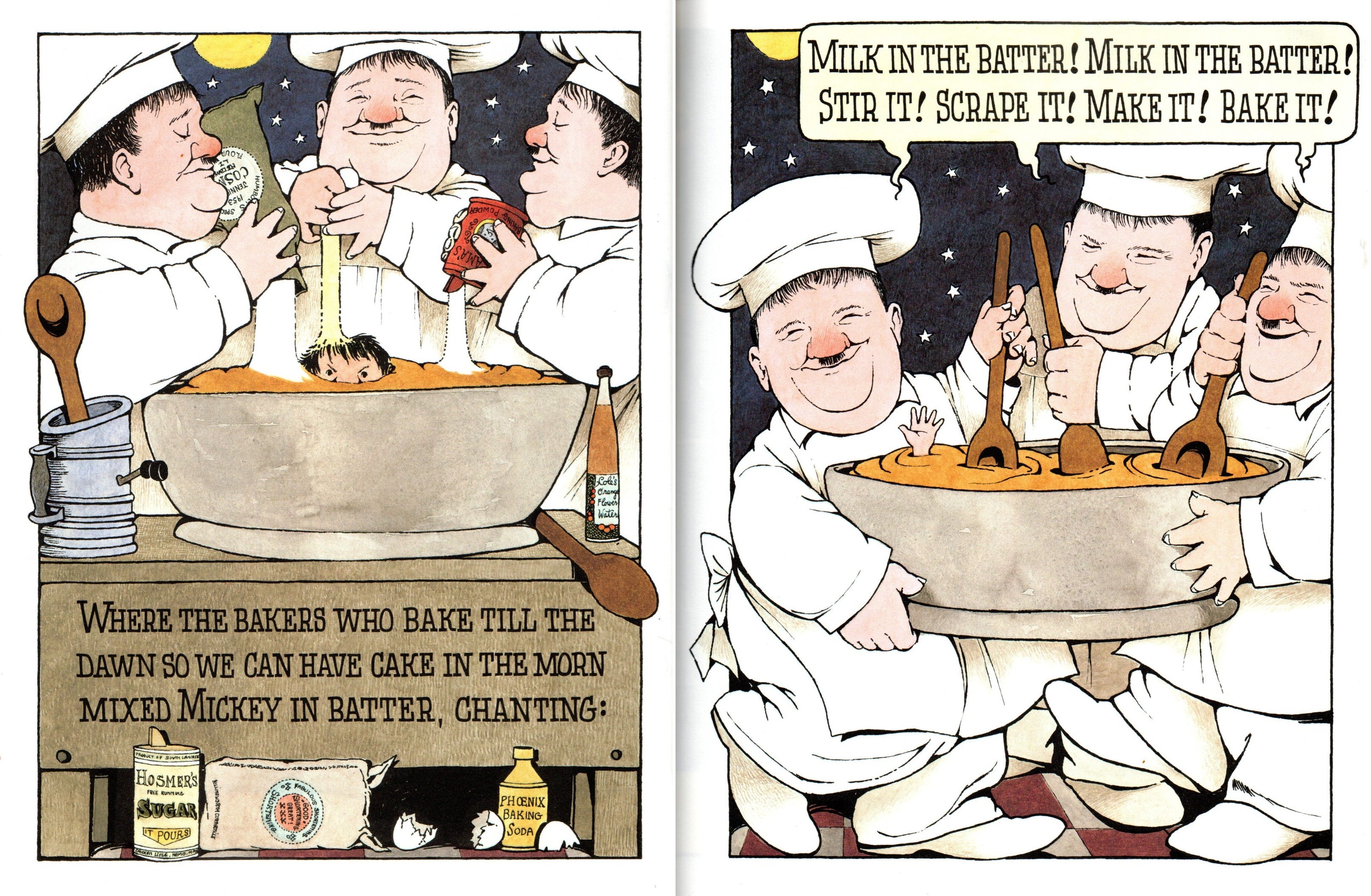
Sendak’s book received quite a lot of pushback when it was initially published from parents, librarians, and educators who thought Sendak’s “wild things” would be too scary for children to handle. Speaking for myself, I’ve been reading Where the Wild Things Are my whole life and I never remember, even as a child, being scared of the monsters depicted therein. Where the Wild Things Are was the only one of Sendak’s books I was familiar with until last week when I got on a big Sendak kick and checked out every book of his from the library; and here’s the strange thing—I am slightly terrified by the bakers in In the Night Kitchen. I think it’s because they all look exactly the same, or maybe because they are so absent-mindedly jolly. They aren’t even aware there is a whole person in their cake batter.
11
The early parts of Art and Illusion deal primarily with how even the most realistic painting is filtered through the artist’s perception and doesn’t really show us the truth about reality. Artists are not passive; they actively select what they want to depict, at times making the choice due to the limits of their chosen medium. Gombrich quotes this short lyric by Nietzsche:
“All Nature faithfully”—But by what feint
Can Nature be subdued to art’s constraint?
Her smallest fragment is still infinite!
And so he paints but what he likes in it.
What does he like? He likes, what he can paint!
12
In Plough, Sean Rubin recounts his mother’s conversion story. She was raised a Catholic but never felt a personal connection to the faith; throughout her early adulthood she drifted through various religious and philosophical movements until one time while she was looking at Georges la Tour’s Adoration of the Shepherds and focusing on the shadowy figure in the background of the painting. As Rubin tells it:
My mother told me this story often enough that I can still hear it in her voice. “I realized I was the peasant with the smirk! I never disrespected Jesus. Why would I? He had been a good moral teacher, and then he was killed. I finished reading the rest of the book, and when I closed the cover I yelled out, almost involuntarily, ‘Oh my God—Jesus is the Messiah!’”
It’s a fine account of how art can direct people towards the truth. The degree to which art is able to do this, on its own, without any textual mediation, is, of course, the great question up for debate—a debate which has continued from the early centuries of the church up to the present day, and which will likely not be resolved any time soon. Still, I am encouraged when I read Rubin’s account.
13
Aghajanian’s articles, mentioned above, on Christian visual literacy include a quick synopsis of the history of sacred art. However, his account stops at the 17th century, in the midst of the baroque period. It does indeed seem that the style and language of the baroque is, for better or for worse, the culmination of the visual style of sacred art: there is no sacred impressionism, no sacred cubism, no sacred fauvism, etc. It seems the public, official, institutionally-sanctioned art of the church still looks more often than not like Bernini or Caravaggio made it. Why is this? And does this quote from Germain Bazin’s Baroque and Rococo, on the religious art of Rembrandt, have any bearing on the question:
It may seem paradoxical that, in that century of faith, expressions of the Christian Faith that went deepest of all came, through his brush, from Protestant Holland with its rejection of the use of images in worship—at a time when all Catholic Europe was indulging in a regular orgy of images.
14
Two good paintings, both by Norman Rockwell: Lion and his Keeper (1954) and Jury Room (1959). Both of these pictures display Rockwell’s supremely adept handling of the picture plane; in both, the action is confined to a very narrow space with almost no delineation into the typical foreground / middleground / background. Also in both, he subtly directs the eye to a single point, balancing vast areas where almost nothing is happening (in the case of Jury Room, he fills the top of the canvas with literal smoke) with passages of intense detail. This detail is intense psychologically as well as pictorially. Rockwell’s genius lies in enabling the viewer to come to an understanding of his subjects’ mental state, doing so in a way that is imminently relatable and understandable. His paintings have little ambiguity in them and their value lies more in the solidity of the truth they reveal and not in their depth of interpretation. Rockwell doesn’t say “puzzle over my work and you’ll find a plethora of meanings in it;” rather, he says “here; I know you’ve felt exactly like this before.” I’m becoming more and more persuaded that Norman Rockwell is the best painter America has yet produced.

